PAGE UNDER CONSTRUCTION
This page currently provides an early overview of the project.
A complete visual system breakdown and final showcase video are in development.
Project Overview
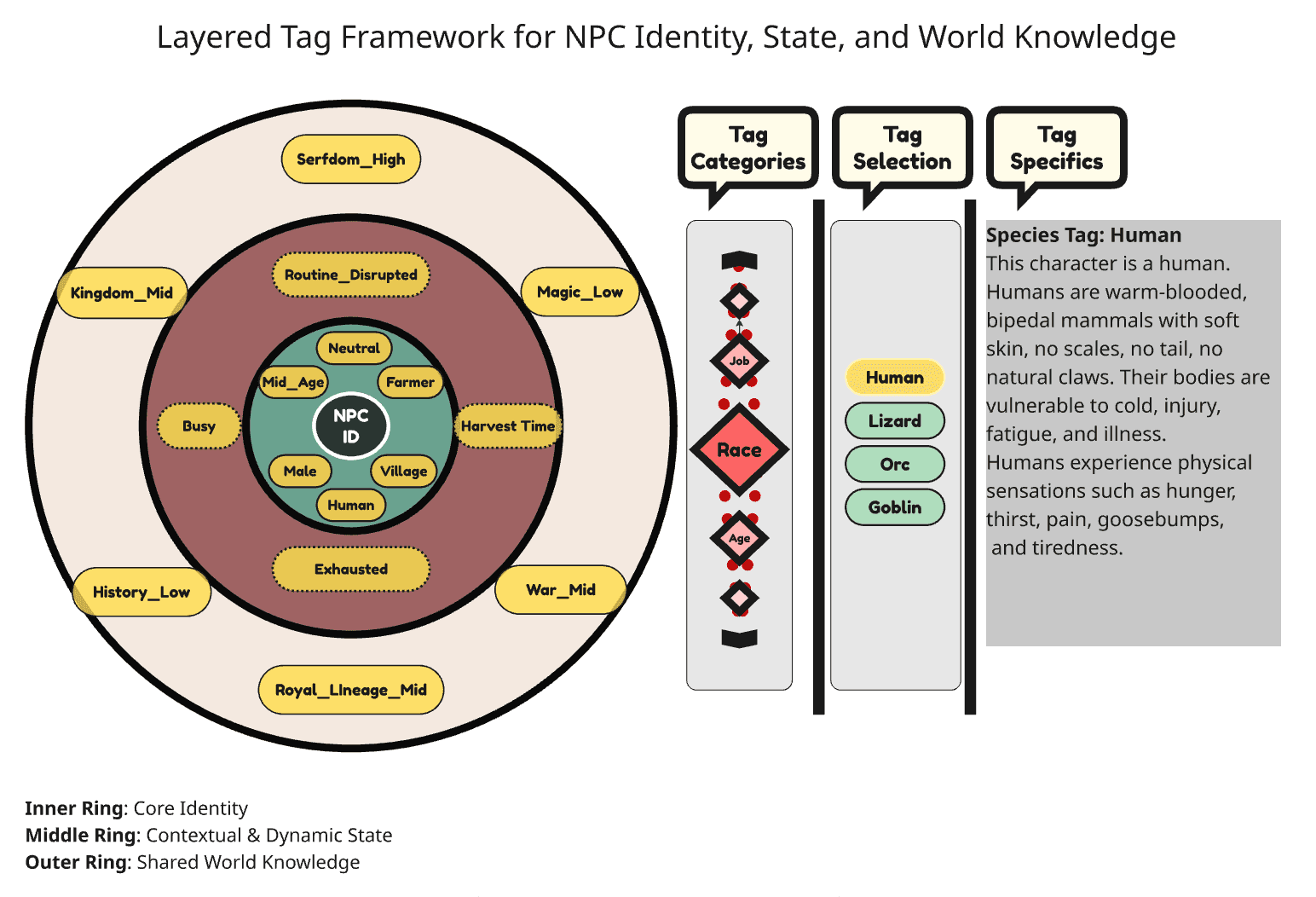
My Bachelor thesis explores how AI-powered NPCs can contribute to immersion and narrative depth in video game worlds. Rather than treating generative AI as an unrestricted conversational tool, the project proposes a theoretical, design-oriented framework for controlling what an NPC knows, remembers, experiences and communicates.
The framework is intended for narrative-driven games, especially RPGs, and focuses on preserving character identity, world consistency and meaningful consequences. It does not present a finished technical implementation. Instead, it offers adaptable design structures that could guide future collaboration between narrative designers, systems designers, quest designers and programmers.
How Can AI-Powered NPCs Contribute to Immersion and Narrative Depth in Video Game Worlds?
The Design Problem
Current AI-driven NPC systems can produce flexible and natural-sounding dialogue, but linguistic fluency alone does not create a believable character. Without clear design boundaries, NPCs may contradict established lore, know information they should not possess, forget previous events, accept fabricated player claims, or describe consequences that never affect the game world.
Open dialogue can weaken character consistency and narrative authority.
NPCs may appear omniscient or share the same generic knowledge.
Conversations may acknowledge events without changing quests, behavior or world state.
Unfiltered memory can become inconsistent, bloated or difficult to maintain.
External system rules can become visible and break the fictional frame.
Design Goal
The project reframes AI-powered NPCs as designed narrative systems rather than autonomous storytellers. Generative dialogue remains possible, but it operates inside designer-authored structures that define identity, context, knowledge, memory and consequence.